
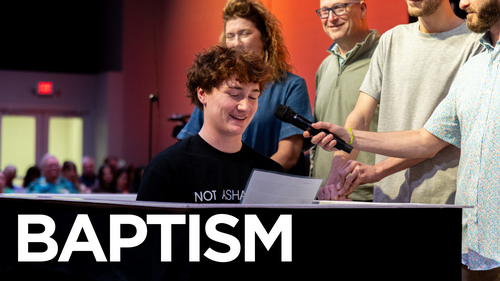
BAPTISM FAQ
What does baptism mean?
Baptism is the God-given sign of our union with Christ. It visibly identifies us with Jesus in his death, burial, and resurrection (Rom. 6:4). Going under the water pictures our old life being buried with Christ; rising from the water demonstrates that we now walk in newness of life through his power. Baptism is not the means of salvation, but the God-ordained way we publicly declare that we belong to Jesus.
In Scripture, baptism also marks our inclusion in the New Covenant community. Paul ties baptism to the "circumcision made without hands," showing that baptism represents the inward realities of repentance, faith, and a new heart (Col. 2:11-12). Only those who have experienced this spiritual renewal can rightly portray it in baptism.
Key Texts: Romans 6:3-4; Colossians 2:11-12; 1 Peter 3:21
In Scripture, baptism also marks our inclusion in the New Covenant community. Paul ties baptism to the "circumcision made without hands," showing that baptism represents the inward realities of repentance, faith, and a new heart (Col. 2:11-12). Only those who have experienced this spiritual renewal can rightly portray it in baptism.
Key Texts: Romans 6:3-4; Colossians 2:11-12; 1 Peter 3:21
What is the connection between baptism and church membership?
In the New Testament, baptism is the initiatory act into the visible church. Just as circumcision marked entry into the Abrahamic covenant, baptism -- circumcision's New Covenant successor (Col. 2:11-12) -- marks entry into the New Covenant community . Paul says that "in one Spirit we were all baptized into one body" (1 Cor. 12:13). The apostles assumed that those who professed faith, received the Spirit, and were baptized were added to the church and joined its shared life of discipleship, gifts, and mission.
Because baptism is the public profession of faith and the biblical entry point into the New Covenant people of God, it naturally precedes membership. Baptism safeguards the church's witness by ensuring that its members have openly identified with Christ and committed themselves to follow Him.
Key Texts: Acts 2:38-41; Colossians 2:11-12; 1 Corinthians 12:12-13
Because baptism is the public profession of faith and the biblical entry point into the New Covenant people of God, it naturally precedes membership. Baptism safeguards the church's witness by ensuring that its members have openly identified with Christ and committed themselves to follow Him.
Key Texts: Acts 2:38-41; Colossians 2:11-12; 1 Corinthians 12:12-13
Who should perform the baptism?
Baptism should be administered by the local church through those entrusted with teaching and shepherding authority. In the New Testament, baptisms were performed by recognized leaders or by those acting under the commission of the church's authority (Matt. 28:18-20; Acts 10:47-48).
Because baptism marks someone's entrance into the church, it is fitting that pastors or designated leaders, acting on behalf of the congregation, administer it. While the individual performing the baptism matters less than the church's oversight, baptism should always be a church act, not an isolated or private one. At the Orchard, our elders oversee baptism and meet with all potential baptizers. See below in the practicals section for more insight into our practice.
Key Texts: Matthew 28:18-20; Acts 10:47-48; Acts 2:41
Because baptism marks someone's entrance into the church, it is fitting that pastors or designated leaders, acting on behalf of the congregation, administer it. While the individual performing the baptism matters less than the church's oversight, baptism should always be a church act, not an isolated or private one. At the Orchard, our elders oversee baptism and meet with all potential baptizers. See below in the practicals section for more insight into our practice.
Key Texts: Matthew 28:18-20; Acts 10:47-48; Acts 2:41
Why does baptism matter?
Baptism matters because Jesus commanded it. The Great Commission is clear: make disciples, baptize them, and teach them (Matt. 28:19-20). To follow Jesus is to obey His call to publicly identify with Him. Beginning your walk with Christ through obedience in baptism demonstrates a willingness to obey Jesus with the rest of your life. Baptism is not optional or secondary-it is a matter of joyful obedience.
Baptism also matters because it is the God-designed picture of the gospel. It dramatizes our union with Christ, proclaims our repentance and faith, and testifies that our old life has ended and a new one has begun (Rom. 6:4). When we give baptism the weight and joy it deserves, we honor the gospel it so beautifully reflects.
Key Texts: Matthew 28:19-20; Romans 6:3-4; 1 Peter 3:21
Baptism also matters because it is the God-designed picture of the gospel. It dramatizes our union with Christ, proclaims our repentance and faith, and testifies that our old life has ended and a new one has begun (Rom. 6:4). When we give baptism the weight and joy it deserves, we honor the gospel it so beautifully reflects.
Key Texts: Matthew 28:19-20; Romans 6:3-4; 1 Peter 3:21
Who should be baptized? Infants? Children?
The consistent pattern of the New Testament is that baptism follows repentance and faith. Peter's command is "repent and be baptized" (Acts 2:38}. Jesus tells us to make disciples and then baptize them (Matt. 28:19). Every recorded baptism in Acts follows a personal profession of faith in Jesus. Infants cannot repent, believe, or appeal to God for a good conscience (1 Pet. 3:21}, so they are not proper candidates for baptism.
We gladly baptize children who demonstrate a genuine understanding of the gospel and a credible profession of faith. The key question is not age but comprehension and sincerity. Baptism is for believers, regardless of how young or old they may be when they trust in Christ.
Key Texts: Acts 2:38-41; Matthew 28:19; 1 Peter 3:21
We gladly baptize children who demonstrate a genuine understanding of the gospel and a credible profession of faith. The key question is not age but comprehension and sincerity. Baptism is for believers, regardless of how young or old they may be when they trust in Christ.
Key Texts: Acts 2:38-41; Matthew 28:19; 1 Peter 3:21
How should believers be baptized?
The New Testament pattern and the meaning of the word baptize ("to immerse, dip, or plunge"} indicate that baptism should be by immersion. Immersion best displays the gospel-picture of burial and resurrection-going under the water represents death with Christ; rising out of the water symbolizes being raised with Him through faith (Rom. 6:4; Col. 2:12).
While sprinkling and pouring were sometimes practiced historically, they do not communicate the biblical imagery with the clarity immersion provides. Because baptism is meant to visually proclaim the gospel, we follow the mode that Scripture's symbolism most naturally demands.
At the Orchard, membership begins with believer's baptism. Those baptized as infants or not immersed as a believer are invited to be baptized as believers, and we are glad to walk with you through that step. For those already baptized as believers by immersion at a sister church, we gladly recognize that baptism for membership.
Key Texts: Romans 6:3-4; Colossians 2:12; Acts 8:38-39
While sprinkling and pouring were sometimes practiced historically, they do not communicate the biblical imagery with the clarity immersion provides. Because baptism is meant to visually proclaim the gospel, we follow the mode that Scripture's symbolism most naturally demands.
At the Orchard, membership begins with believer's baptism. Those baptized as infants or not immersed as a believer are invited to be baptized as believers, and we are glad to walk with you through that step. For those already baptized as believers by immersion at a sister church, we gladly recognize that baptism for membership.
Key Texts: Romans 6:3-4; Colossians 2:12; Acts 8:38-39
Where should believers be baptized?
Baptism should be performed in the gathering or presence of the church. Because baptism is a public declaration of faith and an entrance into the local body, the church should witness, celebrate, and affirm it together. The location itself has historically been flexible - indoors, outdoors, baptistry, river, or pool - but the church's gathered affirmation is essential.
What matters most is not the body of water but the body of believers. Baptism belongs in the context of corporate worship, where the church can welcome the new believer into the family and commit to walk with them in discipleship.
Key Texts: Acts 2:41; 1 Corinthians 12:13
What matters most is not the body of water but the body of believers. Baptism belongs in the context of corporate worship, where the church can welcome the new believer into the family and commit to walk with them in discipleship.
Key Texts: Acts 2:41; 1 Corinthians 12:13
When should a person be baptized?
In Scripture, baptism follows conversion without unnecessary delay. After hearing the gospel, people believed and were baptized, often on the same day (Acts 2:41; Acts 10:47-48). While we want to be sure a person understands the gospel and has made a sincere profession of faith, we also want to honor the New Testament pattern of prompt obedience. Practically, our church baptizes on the last Sunday of each month to allow for preparation, testimony, and pastoral clarity. Still, the heart behind Scripture's example remains: once someone repents and believes, baptism should follow soon after.
Key Texts: Acts 2:38-41; Acts 8:12; Acts 10:47-48
Key Texts: Acts 2:38-41; Acts 8:12; Acts 10:47-48
How often should someone be baptized?
Biblically, baptism is a one-time act. Because it symbolizes our once-for-all union with Christ in His death and resurrection, it is not repeated. Scripture never portrays re-baptism except in cases where a previous baptism occurred before someone truly believed (Acts 19:1-5).
If a person was baptized as an infant or before they genuinely trusted Christ, they should be baptized as a believer. But for those who were baptized after their conversion, no second baptism is necessary-Christ's work, and the baptism that publicly portrays it, is complete.
At the Orchard, all members enter through Believer's Baptism. Those baptized as infants or not immersed as a believer are invited to be baptized as believers, and we are glad to walk with you through that step. For those already baptized as believers by immersion at a sister church, we gladly recognize that baptism for membership.
Key Texts: Acts 19:1-5; Romans 6:3-4
If a person was baptized as an infant or before they genuinely trusted Christ, they should be baptized as a believer. But for those who were baptized after their conversion, no second baptism is necessary-Christ's work, and the baptism that publicly portrays it, is complete.
At the Orchard, all members enter through Believer's Baptism. Those baptized as infants or not immersed as a believer are invited to be baptized as believers, and we are glad to walk with you through that step. For those already baptized as believers by immersion at a sister church, we gladly recognize that baptism for membership.
Key Texts: Acts 19:1-5; Romans 6:3-4
How does baptism relate to the Lord's Supper?
Baptism marks the beginning of the Christian life; the Lord's Supper nourishes and renews us along the way. Baptism is the front door -- the initiatory rite -- into the church, and the Lord's Supper is the family meal for those already inside. In the New Testament, believers are baptized into the body (1 Cor. 12:13), and then they share in the ongoing fellowship and remembrance of Christ's death through the Supper (1 Cor. 11:23-26). Baptism says, "I belong to Jesus," and the Lord's Supper says, "I continue with Jesus and His body until He comes."
Because baptism is the way we publicly identify with Christ and His people, it naturally comes before participating in the Lord's Supper. In a very real sense, it protects and prepares us. Paul urges believers to "examine themselves" so that we don't approach the Table in an "unworthy manner," and he warns that treating the Supper lightly brings spiritual harm rather than blessing (1 Cor. 11:27-30). Baptism, as an act of obedience and a sign of genuine faith, provides a clear and tangible way for someone to make that self-examination.
For this reason, if someone has come to faith but has not yet been baptized, we simply ask them to refrain from taking the Lord's Supper for now. Those who have already scheduled their baptism and are simply waiting for our team to facilitate it are encouraged to take part. This isn't meant to restrict worship but to guide it. It's a gentle invitation to receive God's gifts in the rhythm He intended: the waters that welcome us in, and the meal that sustains us once we're home.
Key Texts: 1 Corinthians 12:13; 1 Corinthians 11:23-30
Because baptism is the way we publicly identify with Christ and His people, it naturally comes before participating in the Lord's Supper. In a very real sense, it protects and prepares us. Paul urges believers to "examine themselves" so that we don't approach the Table in an "unworthy manner," and he warns that treating the Supper lightly brings spiritual harm rather than blessing (1 Cor. 11:27-30). Baptism, as an act of obedience and a sign of genuine faith, provides a clear and tangible way for someone to make that self-examination.
For this reason, if someone has come to faith but has not yet been baptized, we simply ask them to refrain from taking the Lord's Supper for now. Those who have already scheduled their baptism and are simply waiting for our team to facilitate it are encouraged to take part. This isn't meant to restrict worship but to guide it. It's a gentle invitation to receive God's gifts in the rhythm He intended: the waters that welcome us in, and the meal that sustains us once we're home.
Key Texts: 1 Corinthians 12:13; 1 Corinthians 11:23-30

ORCHARD PRACTICALS
Does this mean we are Baptists?
A lot of people bring a lot of different assumptions to the word "Baptist." For some, that word is comforting; for others, it raises concerns. We get that.
What's important to remember is that "baptist" is first a theological conviction before it's ever a denomination. Some who hold these convictions belong to a Baptist denomination; others are completely nondenominational. But the core ideas are the same: the sufficiency of Scripture, a regenerate church membership, believer's baptism (as outlined above), and the autonomy of the local church. If these are your convictions, you're a baptist theologically, and they're convictions the Orchard gladly upholds.
Historically, evangelism and missions have also been at the heart of Baptist identity. Baptists have long linked arms for the sake of the gospel-planting churches, sending missionaries, and serving their communities-even when they've disagreed on plenty of other things. In that same spirit, the Orchard cooperates with other churches in the Southern Baptist Convention. The SBC isn't perfect-no network or denomination is-but we joyfully partner in Kingdom work to spread the hope of Jesus.
What's important to remember is that "baptist" is first a theological conviction before it's ever a denomination. Some who hold these convictions belong to a Baptist denomination; others are completely nondenominational. But the core ideas are the same: the sufficiency of Scripture, a regenerate church membership, believer's baptism (as outlined above), and the autonomy of the local church. If these are your convictions, you're a baptist theologically, and they're convictions the Orchard gladly upholds.
Historically, evangelism and missions have also been at the heart of Baptist identity. Baptists have long linked arms for the sake of the gospel-planting churches, sending missionaries, and serving their communities-even when they've disagreed on plenty of other things. In that same spirit, the Orchard cooperates with other churches in the Southern Baptist Convention. The SBC isn't perfect-no network or denomination is-but we joyfully partner in Kingdom work to spread the hope of Jesus.
What should you wear?
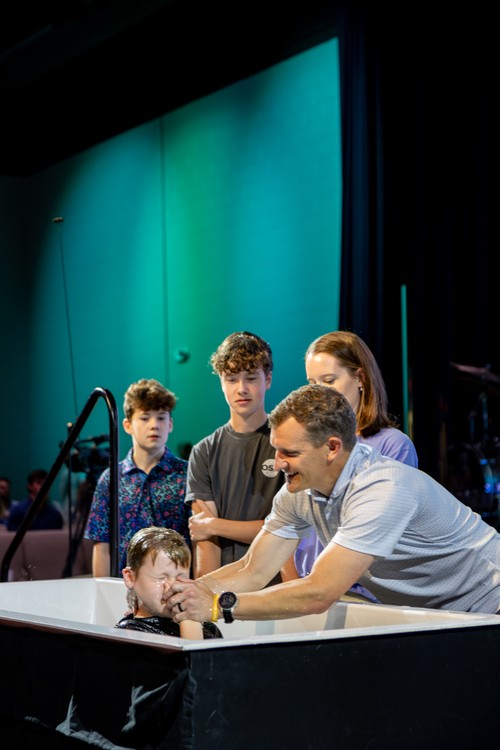
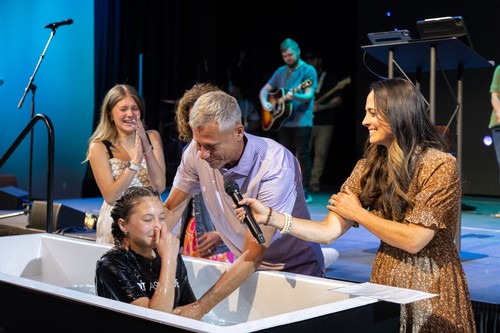
You're going to get wet! We ask everyone being baptized to bring a pair of dark shorts to change into. We'll provide a shirt for you to wear, along with a towel. When you arrive, our deacons will be ready to help you and show you where to change.
When are our baptism services?
We plan baptism services for the last Sunday of each month. You can be baptized in whichever service is best for you. Our team will accommodate any way that we can!
Who performs baptism at The Orchard?
Most often, it is one of our elders or leaders. We take special requests on a case-by-case basis, though there would be a vetting process involved.
What is the process to be baptized at The Orchard?
Simply click on the Baptism Application button at the top of this website, or reach out to any of our staff and elders to get the ball rolling. We'll send you a short baptism application, and we'll line up conversation with one of our team members to get to know you. During that conversation, we'll nail down all of the details.